





Column Treatment Progress Report No. 217: A Patient Who Was Struggling with Leg Numbness Caused by Spinal Canal Stenosis
September 19, 2026
The patient
A female patient in her 80s.
Treated in October 2025. Approximately 10 months have passed since treatment.
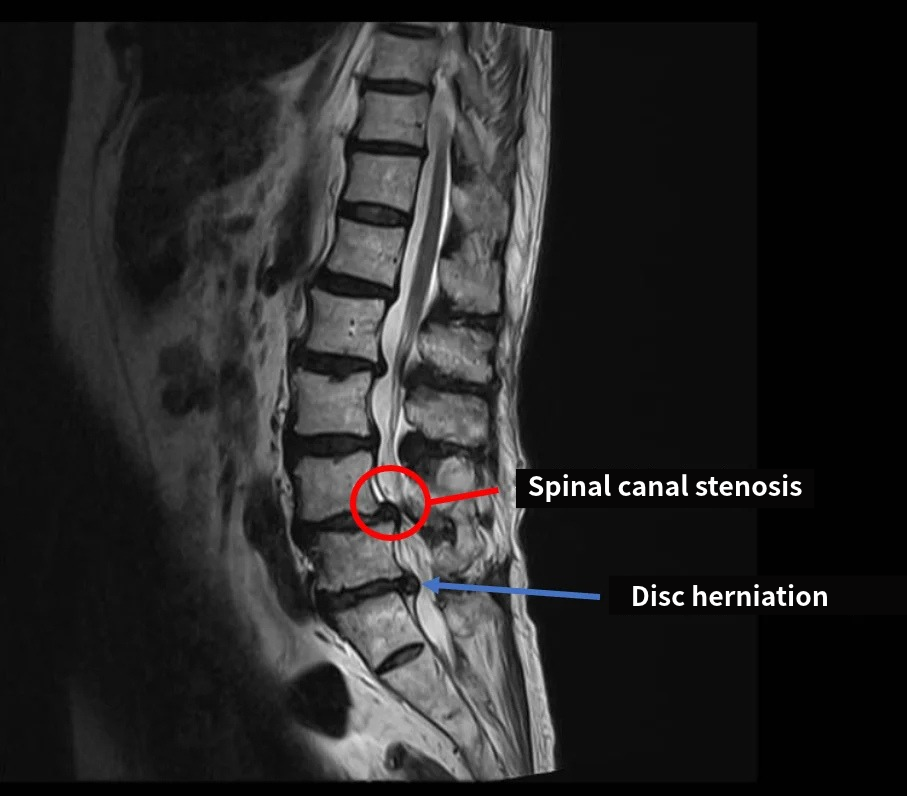
Symptoms and treatments to date
This patient had spinal canal stenosis at the level indicated by the red frame (L4/5), and a disc herniation at the level indicated by the blue arrow (L5/S).
Pre-treatment medical history and treatments to date
In June 2021, the patient fell off her bicycle, leading to severe pain in her lower back and legs.
Although the pain improved afterward, numbness remained.
She was advised to undergo surgery to remove damaged cartilage, but she decided against it because she was concerned that it would be detrimental to her hobbies.
Post-treatment progress
The table below shows the results of the patient’s own evaluation of the pain in each body site on a scale of 0 to 10.
No pain at all is rated as 0 and 10 as the maximum possible pain.
| Lower back | Lower limbs | Numbness | Buttocks | |
|---|---|---|---|---|
| Before treatment | 1 | 2 | 8 | 2 |
| 1 week after treatment | 1 | 0 | 7 | 0 |
| 1 month after treatment | 1 | 0 | 8 | 0 |
| 3 months after treatment | 0 | 0 | 2 | 0 |
| 6 months after treatment | 0 | 0 | 2 | 0 |
The following is feedback from the patient when contacted for follow-up.
1 week after treatment:
The sensation of numbness felt about the same.
1 month after treatment:
Although the symptoms had not worsened, the numbness remained. She made a point of building a walking habit and increased the distance she walked to commute.
3 months after treatment:
The numbness in the lower leg and the front of the right thigh had decreased. However, numbness remained in the back and side of the leg and in the sole of the foot.
6 months after treatment:
Getting up in the morning had become easier. However, sitting for a long time has become uncomfortable.
We believe that the patient’s main symptoms were primarily related to spinal canal stenosis.
Three months after treatment, the numbness had decreased, and an improvement in symptoms was observed.
The patient was particularly motivated to walk and took an active approach to improving her physical activity.
We expect further improvement if she continues training and stretching in the future.
* It generally takes 3 weeks to 3 months for treatment effects to appear.
* Effects in the treatment may vary according to individual differences. Please be aware that there is a possibility that the exact same effects may not be replicated every time.
Our Treatment Method
Supplementary Information on the Cellgel Method
Cost of the Cellgel Method:
¥1,320,000 / 1 site (tax included)
to ¥1,760,000 / 5 sites (tax included)
Risks and Side Effects:
Temporary pain may occur after treatment.
Nerve injury is theoretically possible due to the nature of the procedure, but no such cases have been reported in our own experience or in published studies.
Extremely rare risk of allergic reaction to local anesthetic.
Symptoms may temporarily worsen for 1–2 weeks after treatment, believed to be due to decompression effects of the implant pulling on surrounding tissue.
If the disc is severely collapsed or nearly gone, treatment may not be possible.
The physician will discuss suitable treatment options with each patient depending on their condition.
For more detailed information, please refer to the following links:
Blog page explaining the Cellgel Method in an easy-to-understand manner
The Cellgel Method on our treatment methods page
This article was written by the administrative Director of our clinic