





Column Treatment Progress Report No. 218 | A Patient Who Suffered from Pain in the Lower Limbs and Buttocks
September 30, 2026
The patient
A female patient in her 70s.
Treated in October 2025 (more than 11 months have passed since treatment).
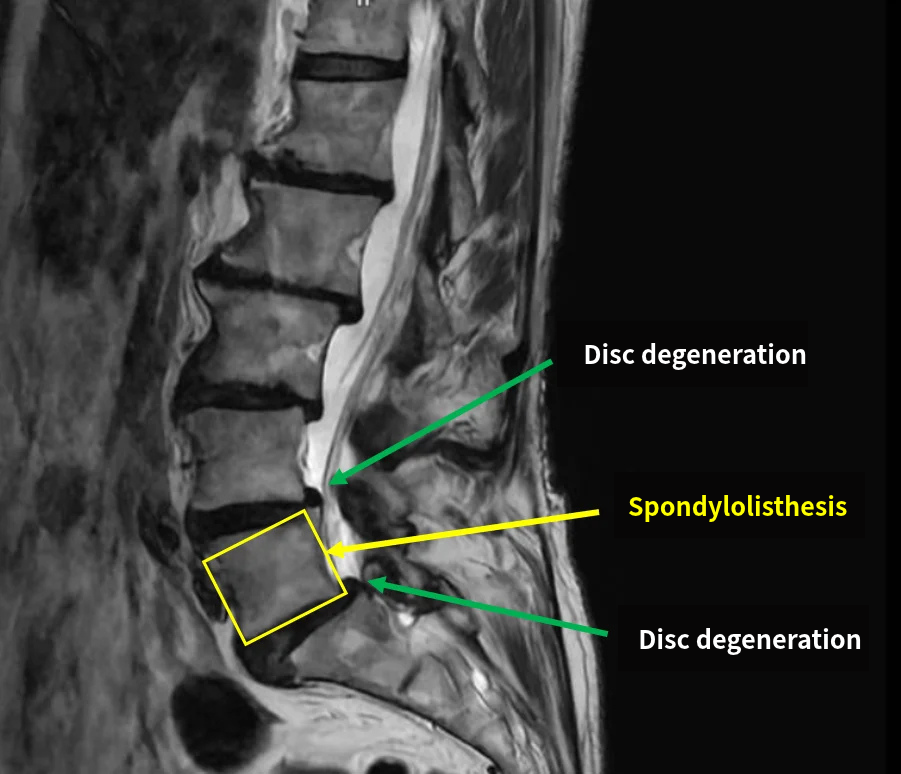
Symptoms and treatment
This patient has spondylolisthesis at the level indicated by the yellow box (L5), and disc degeneration at the levels indicated by the green arrows (L4/5 and 5/s).
The patient’s medical history to date
In 2022, the patient suddenly developed pain extending from her right buttock to the outer side of her right leg.
She visited several orthopedic clinics and was diagnosed with spondylolisthesis.
She tried various treatments, including pain medication, nerve block injections, and massage, but none provided significant relief.
As she wished to undergo treatment without an overnight hospital stay, she came to our clinic for consultation.
Post-treatment progress
The table below shows the results of the patient’s own evaluation of the pain in each body site on a scale of 0 to 10.
No pain at all is rated as 0 and 10 as the maximum possible pain.
| Lower back | Lower limbs | Numbness | Buttocks | |
|---|---|---|---|---|
| Before treatment | 0 | 8 | 0 | 8 |
| 1 week after treatment | 0 | 8 | 0 | 8 |
| 1 month after treatment | 0 | 0 | 0 | 0 |
| 6 months after treatment | 0 | 3 | 0 | 0 |
The following is feedback from the patient when contacted for follow-up.
One week after treatment: The patient reported that pain in her lower limbs and buttocks persisted for a while after getting up in the morning and after getting up to use the toilet during the night. Once she started moving, the pain gradually eased.
One month after treatment: The patient reported that the pain had disappeared when sitting.
Six months after treatment: The patient reported that the pain had been very severe for the first two months after treatment but had gradually subsided thereafter. Although she still experienced pain in the back of her thigh, she is now able to do water walking exercises every day.
The patient’s symptoms were considered to be primarily associated with intervertebral disc degeneration.
Although results vary from person to person, some patients may experience a temporary increase in pain after treatment.
This patient experienced a similar course. However, by exercising within her physical limits, she was able to work through the pain and gradually improve.
* It generally takes 3 weeks to 3 months for treatment effects to appear.
* Effects in the treatment may vary according to individual differences. Please be aware that there is a possibility that the exact same effects may not be replicated every time.
Our Treatment Method
Supplementary Information on the Cellgel Method
Cost of the Cellgel Method:
¥1,320,000 / 1 site (tax included)
to ¥1,760,000 / 5 sites (tax included)
Risks and Side Effects:
Temporary pain may occur after treatment.
Nerve injury is theoretically possible due to the nature of the procedure, but no such cases have been reported in our own experience or in published studies.
Extremely rare risk of allergic reaction to local anesthetic.
Symptoms may temporarily worsen for 1–2 weeks after treatment, believed to be due to decompression effects of the implant pulling on surrounding tissue.
If the disc is severely collapsed or nearly gone, treatment may not be possible.
The physician will discuss suitable treatment options with each patient depending on their condition.
For more detailed information, please refer to the following links:
Blog page explaining the Cellgel Method in an easy-to-understand manner
The Cellgel Method on our treatment methods page
This article was written by the administrative Director of our clinic