





Column Treatment Options and Precautions to Take in Daily Life if You Are Diagnosed with Spondylolysis or Spondylolisthesis
August 14, 2026
Lumbar spondylolysis is more prevalent in younger people.
The risk of developing degenerative lumbar spondylolisthesis also increases with age.
This article explains the characteristics, causes, symptoms, and treatment options for both conditions.
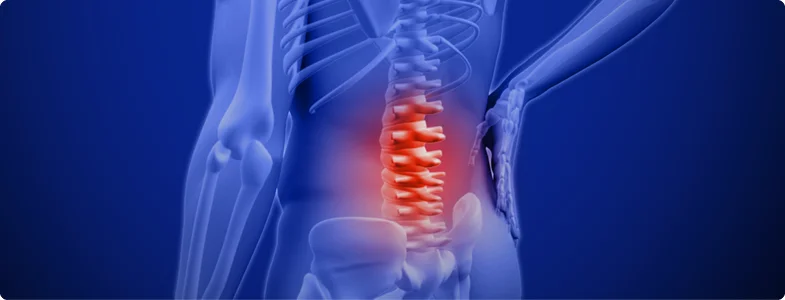
Lumbar Spondylolysis: More Common in Younger People
Younger individuals (particularly middle and high school students) often develop lumbar spondylolysis due to repetitive stress on the lumbar spine caused by sports and physical activities.
If the condition is detected at an early stage and the patient stops participating in sports right away, the bone may have a chance to heal. However, if left untreated, the fracture may fail to heal and develop into a pseudarthrosis (or false joint), which can lead to chronic low back pain later on.
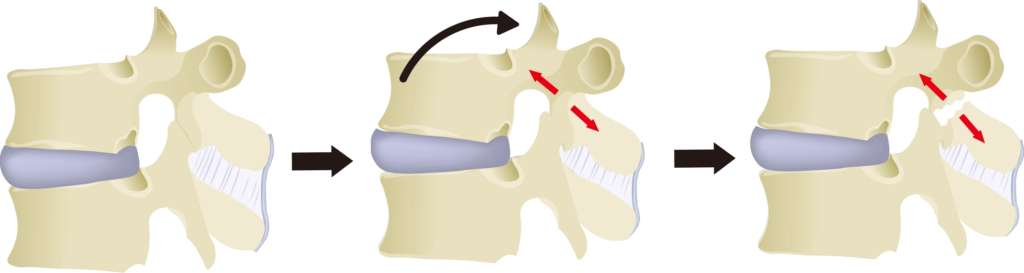
Primary Causes of Lumbar Spondylolysis
Possible causes of spondylolysis and degenerative lumbar spondylolisthesis include:
- Reduced flexibility of the hip joints
- Reduced strength of the hip muscles
- Repetitive lumbar extension and twisting movements
- Repeated high-impact activities such as landing from jumps
Lumbar spondylolysis is common in adolescents engaging in sports like soccer, track and field, baseball, basketball, and volleyball.
Symptoms of Lumbar Spondylolysis
While lower back pain is the primary symptom, the following characteristics are also typically exhibited:
☑ Pain eases during rest or inactivity
☑ A dull pain may occur on one side of the lower back, or from the buttocks to the thigh
☑ In the early stages, it is easy to mistake the symptoms for ordinary muscle soreness
☑ Lower back pain persists for more than 2 weeks
How to Manage Lumbar Spondylolysis
In the early stages, taking a break from sports for several months while wearing a supportive lumbar brace can facilitate bone healing.
After pain subsides, rehabilitation to strengthen muscles surrounding the lower back is essential.
If lower back pain persists for more than 2 weeks, avoid pushing through the pain and quiclky consult a specialist.
Continuing sports despite the pain may lead to complete bone separation, with chronic back pain or progression to spondylolisthesis. That is why appropriate management is crucial.
Lumbar Spondylolisthesis Increases with Age
The incidence of degenerative lumbar spondylolisthesis increases with age.
Spondylolisthesis occurs when intervertebral discs, ligaments, or facet joints supporting the spine weaken and become unstable, causing the upper vertebra to slip forward and compress nearby nerves. This condition occurs more frequently in women and in people aged 40–50 and older.
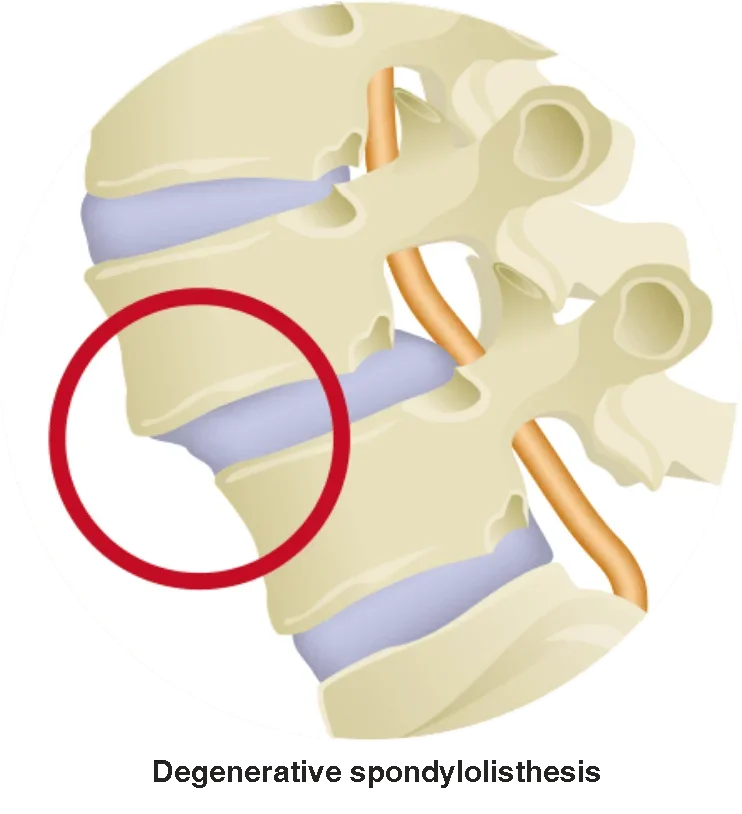
Primary Symptoms of Lumbar Spondylolisthesis
Mild spondylolisthesis is often asymptomatic in its early stages. In many cases, patients only undergo examination once symptoms manifest themselves, by which time the condition may have already significantly progressed.
The main symptoms of lumbar spondylolisthesis are lower back pain, as well as pain and numbness in the buttocks and lower limbs. The onset of symptoms depends on the degree of instability caused by the slippage, the extent of degeneration in the intervertebral discs or the site of separation, and the location and severity of nerve compression.
One common symptom of spondylolisthesis is numbness and pain in the buttocks or lower limbs that occurs while walking. Intermittent claudication, in which the patient is able to walk again after a short rest, is also a common occurence.
Degenerative spondylolisthesis is often accompanied by spinal stenosis, and symptoms of stenosis—such as lower limb pain, numbness, intermittent claudication, and urinary dysfunction—may also be present.
The Causes of Lumbar Spondylolisthesis
Spondylolisthesis often develops as a result of long-term participation in sports or other activities from a young age, followed by age-related degeneration of the intervertebral discs, ligaments, facet joints, and other structures that are used to stabilize the lumbar spine.
Recent studies indicate that intervertebral disc degeneration is a major underlying factor triggering spondylolisthesis. (*1):I. Akkawi, H. Zmerly. Degenerative Spondylolisthesis: A Narrative Review. Acta Biomedica, vol. 92, No.6, 2021)
As the intervertebral discs degenerate, increased stress is placed on the spine and facet joints. This can lead to instability of the spinal structures and eventually contribute to the development of spondylolisthesis.
Conventional Treatment for Spondylolisthesis
When diagnosed with spondylolisthesis, conservative treatment is generally considered first. If symptoms do not improve with conservative treatment and persist over a prolonged period, surgical treatment may be recommended.
Treatment aims to alleviate symptoms by prescribing anti-inflammatory pain relievers and muscle relaxants; applying electrical stimulation or heat therapy to the affected muscles; or administering local anesthetics to the nerves or areas causing the symptoms.
Surgery is often performed when conservative treatment fails to improve the condition, when there is muscle weakness, or in cases such as dysplastic spondylolisthesis. Under general anesthesia, an incision is made in the lower back. Using a microscope for guidance, the lamina and other structures are removed, and the adjacent vertebral bodies are fused using screws and rods. By stabilizing the slipped lumbar vertebra, the procedure restores stability to the spine and prevents further slippage.
Important Points to Keep in Mind With Lumbar Spondylolysis and Spondylolisthesis
If you have been diagnosed with lumbar spondylolysis or spondylolisthesis, it is important to take appropriate precautions in your daily life.
Movements to Avoid
Movements that involve arching or twisting the lower back place significant stress on the spine and affected area and may worsen symptoms or vertebral displacement.
Excessive stretching and massage should also be avoided.
Activities that involve bending forward or working in a stooped position, such as lifting heavy objects, can place a significant strain on the lumbar spine and should be limited.
Points to Keep in Mind in Daily Life
When working at a desk or driving, avoid maintaining the same posture for long periods. Change your position frequently to prevent prolonged and concentrated strain on the lower back.
When sitting, sit completely in the back of the chair and avoid sitting on the edge. Avoid slouching or excessive arching of the lower back and lightly engage your abdominal muscles to maintain a good posture.
Consider incorporating static exercises such as draw-in exercises and planks to your routine, which help improve core stability without requiring large movements of the spine.
Advanced Treatments Available at Our Clinics
Our clinic provides specialized, minimally invasive procedures targeting disc damage and spinal instability, such as the Cellgel Method, the Florence Method, and the Q-Florence Method.
The Cellgel Method
The Cellgel Method is a treatment designed to repair damaged intervertebral discs.
A medical agent is injected into the damaged or fissured portion of the intervertebral disc. The agent then forms a gel-like substance that fills and reinforces the fissure. This may help prevent further disc degeneration and provide a treatment approach that addresses the underlying disc damage.
One of the characteristics of the Cellgel Method is that the injected agent remains within the intervertebral disc as a gel-like implant, without reducing the volume of the disc. This allows the intervertebral disc itself to be preserved.
The Cellgel Method can be used for lumbar disc degeneration as well as cervical disc degeneration.
Learn More About the Cellgel Method
The Florence Method
With the Florence Method, a special spacer is inserted between the spinous processes of the lumbar vertebrae. This helps stabilize the vertebrae while preserving spinal rotation and flexion, widening the spinal canal, reducing disc protrusion, and alleviating thickening of the ligamentum flavum.
By widening the previously narrowed spinal canal, symptoms such as pain and numbness is relieved.
Learn More About the Florence Method
The Q-Florence Method
The Q-Florence Treatment is a minimally invasive treatment with a low procedural burden that can be performed for lumbar spinal canal stenosis, spondylolisthesis, and lumbar spinal instability.
A specialized device is inserted percutaneously to stabilize the unstable spine, widen the narrowed spinal canal, and improve vertebral slippage.
Learn More About the Q-Florence Method
(article in Japanese)
Additionally, through collaboration with OJ Wellness Center, we integrate Eastern medicine and Ayurvedic approaches to support lower back health across diverse age groups.
Learn More About the OJ Wellness Center
If you are suffering from low back pain or have been diagnosed with lumbar spondylolysis or spondylolisthesis, please consider scheduling an examination with our medical team.
Related Articles
🛌How to Sleep Comfortably When You’ve Been Diagnosed with Spondylolysis and Spondylolisthesis?🛌
Characteristics and Management of Spondylolisthesis For Children