





Column Treatment Case Report No. 75| ILC International Lumbago Clinic (Nagoya Clinic)
July 13, 2026
The patient
A male patient in his 60s.
The patient’s medical history to date
The patient began experiencing lower back pain approximately five years ago. He recalls undergoing an MRI examination and being diagnosed with spondylolisthesis.
His symptoms were relieved with pain medication.
Until around March of this year, he was still able to play golf. However, his pain gradually worsened from around the end of March.
He also started a new job in April, which he feels contributed to his lower back condition worsening.
Around the middle of May, numbness developed. At the orthopedic clinic, he was prescribed pain medication, but it gradually became ineffective. He was told that surgery would be necessary if he became unable to walk.
Pre-treatment symptoms
・Pain levels before treatment
| Lower back | Lower limbs | Numbness | Buttocks | |
|---|---|---|---|---|
| Pain level | 7 | 1 | 6 | 5 |
No pain at all is rated as 0, and the maximum possible pain is rated as 10.
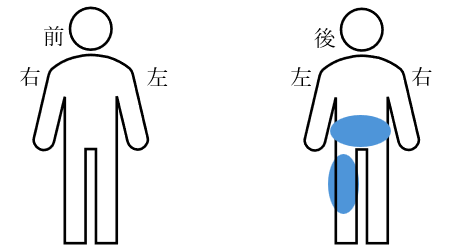
Main areas of pain and numbness: both sides of the lower back and the posterolateral aspect of the left lower limb
Bending forward: no aggravation
Bending backward: induces lower back pain
Lasegue test: negative
Point of tenderness: bilateral tenderness at L5/S
Intermittent claudication: negative
Additional explanations on our clinic’s medical examination
・Daily activities
Golf (currently unable to play)
Imaging and findings
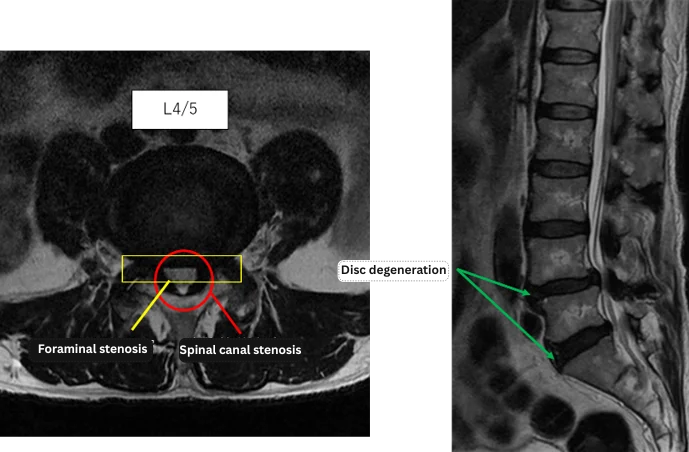
- L1/2: Nothing unusual
- L2/3: Nothing unusual
- L3/4: Nothing unusual
- L4/5: Mild spinal canal stenosis, disc degeneration, and bilateral foraminal stenosis
- L5/S: Disc degeneration and bilateral foraminal stenosis
The above findings were also observed on the imaging.
The imaging findings indicated mild spinal canal stenosis, disc degeneration, and foraminal stenosis at L4/5 and L5/S, which were considered highly likely to be contributing to the patient’s main symptoms.
Treatment
After consulting with the patient, the Cellgel Method was performed on L4/5 and 5/s.
The treatment was performed by Dr. Ban.
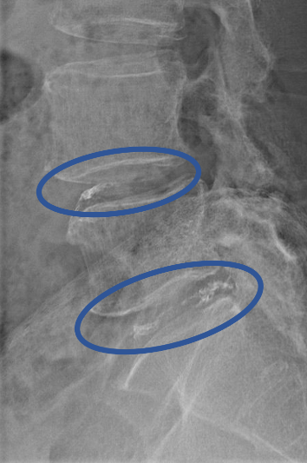
This is an image of the Discogel inserted into the intervertebral disc.
The treatment took about 20 minutes.
After resting in the recovery room, the patient was able to walk home by his own means.
Our Clinics’ Treatment
Additional information about the Cellgel method we have introduced in this column.
Cost of the Cellgel method: 1,320,000 yen per area (including tax) to 1,760,000 yen per 5 areas (including tax)
Risks and side effects of the Cellgel method: Transient pain may occur after treatment. Nerve damage is not a zero possibility due to the very nature of the treatment, but there have been no reports of damage so far in either report cases or publications. There is a very small possibility of allergic reactions to local anesthetics. Symptoms may temporarily worsen during the first week or two after treatment. This is believed to be due to the decompression effect of the implant, which retracts the surrounding tissues. In addition, if the disc is almost completely collapsed, treatment may be difficult. The doctor hold a consultation with you during your visit to the clinic to determine the best treatment option for your condition.
For more detailed information, please refer to the following links:
Blog page explaining the Cellgel Method in an easy-to-understand manner
The Cellgel Method on our treatment methods page