





Column Treatment Progress Report No.15| A Patient Who Had Spinal Canal Stenosis and Intervertebral Disc Degeneration
April 3, 2023
The patient
A male patient in his 70s
Treated in October 2022. Approximately 5 months have passed since treatment.
Symptoms and treatments to date
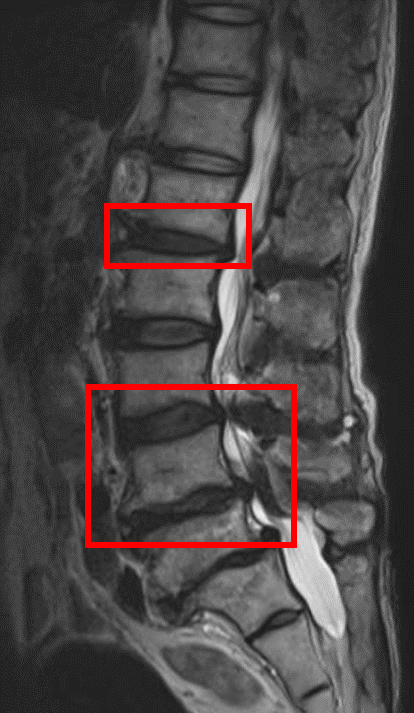
This patient had disc degeneration in the areas indicated by the red frame (L1/2, 3/4, 4/5).
Spinal canal stenosis was also observed at L3/4 and L4/5.
Treatment was not possible at L5/S due to disc narrowing (reduction of space).
Pre-treatment medical history and treatments to date
In 2017, the patient was diagnosed with lumbar spinal canal stenosis and was treated with oral medication, resulting in improvement after approximately six months.
In August 2022, on the night after playing golf, the patient began to experience pain in the lower back and buttock region.
After visiting a local orthopedic clinic, he was informed that surgery was not yet necessary. However, as symptoms failed to improve sufficiently, he subsequently visited our clinic.
Treatment
The Cellgel Method was performed on a total of three disc locations: L1/2, L3/4, and L4/5.
Post-treatment progress
The table below shows the results of the patient’s own evaluation of the pain in each body site on a scale of 0 to 10.
No pain at all is rated as 0 and 10 as the maximum possible pain.
| Lower back | Lower limbs | Numbness | Buttocks | |
|---|---|---|---|---|
| Before treatment | 4 | 4 | 3 | 5 |
| 1 week after treatment | 2 | 1 | 2 | 2 |
| 1 month after treatment | 1 | 1 | 2 | 1 |
| 3 months after treatment | 1 | 0 | 1 | 1 |
The following is feedback from the patient when contacted for follow-up.
After 1 week: Pain remained in the lower back and buttocks, with mild residual numbness.
After 1 month: Both pain and numbness had improved; however, slight numbness was felt when standing up.
After 3 months: Overall symptoms felt lighter, but the patient did not perceive further improvement compared with the previous follow-up.
While the levels of pain and numbness have gradually decreased, the patient himself felt somewhat unsatisfied.
Upon discussion, it was revealed that he had not been exercising much, so we advised him to prioritize exercise moving forward.
Refraining from movement after treatment can lead to a decrease in muscle strength.
While resting for a few days post-treatment is fine, we recommend returning to daily life and exercise within a range that does not cause muscle pain thereafter.
Our clinic features a rehabilitation center specializing in back pain where professional physical therapists can provide guidance on daily exercises.
* Results vary among individuals. Please be aware that identical outcomes cannot be guaranteed.
* It generally takes 3 weeks to 3 months for treatment effects to appear.
Our Treatment Method
Supplementary Information on the Cellgel Method
Cost of the Cellgel Method:
¥1,320,000 / 1 site (tax included)
to ¥1,760,000 / 5 sites (tax included)
Risks and Side Effects:
Temporary pain may occur after treatment.
Nerve injury is theoretically possible due to the nature of the procedure, but no such cases have been reported in our own experience or in published studies.
Extremely rare risk of allergic reaction to local anesthetic.
Symptoms may temporarily worsen for 1–2 weeks after treatment, believed to be due to decompression effects of the implant pulling on surrounding tissue.
If the disc is severely collapsed or nearly gone, treatment may not be possible.
The physician will discuss suitable treatment options with each patient depending on their condition.
For more detailed information, please refer to the following links:
Blog page explaining the Cellgel Method in an easy-to-understand manner
The Cellgel Method on our treatment methods page
This article was written by the administrative Director of our clinic