





Column Could Your Symptoms Be a Sign of Spinal Canal Stenosis? Causes and Management of Pain and Numbness During Walking
April 10, 2026
The condition in which the nerve pathway inside the spine (the spinal canal) becomes narrowed is called spinal canal stenosis.
In this article, we will explain intermittent claudication, one of the most typical symptoms of lumbar spinal canal stenosis.
What is Spinal Canal Stenosis?
Spinal canal stenosis occurs when the spinal canal, which serves as the passageway for nerves in the back, becomes narrowed and compresses the latter. When instability of the lumbar spine is the underlying cause, symptoms are often aggravated by body movement.
Intermittent Claudication, a Typical Symptom of Spinal Canal Stenosis
Lumbar spinal canal stenosis can cause numbness and pain from the lower back down into the legs. A characteristic symptom of it is intermittent claudication, in which pain or numbness develops in the buttocks or legs while walking, improves with rest, but then returns when resuming walk.
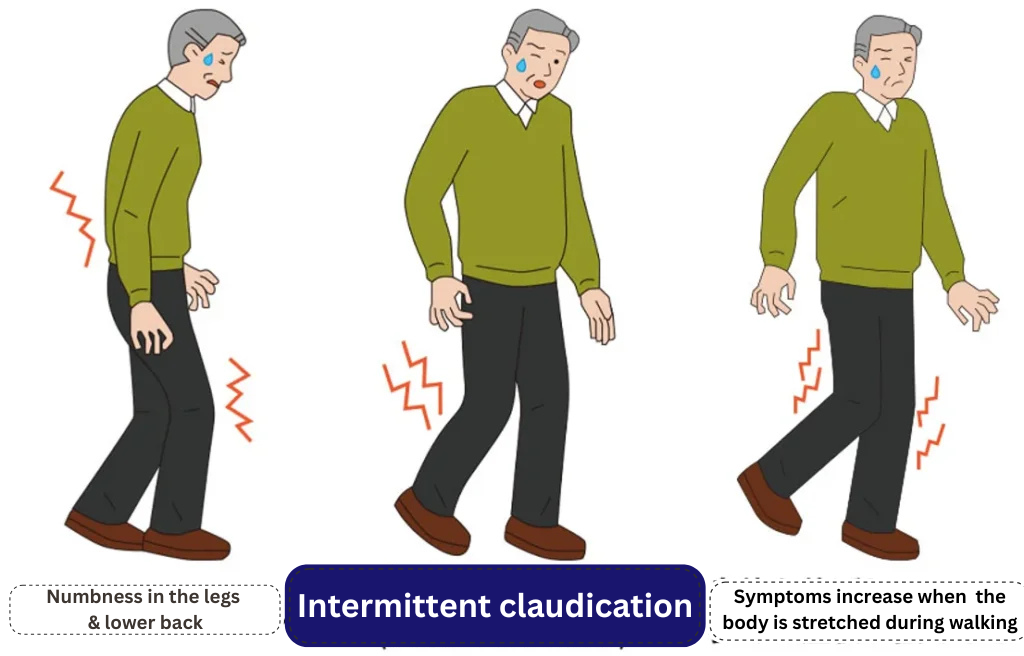
One notable feature of intermittent claudication is that symptoms worsen when standing upright or walking with the back straight, eventually making walking difficult.
Leaning slightly forward while using a cane or walker often relieves the symptoms. Riding a bicycle also tends to cause fewer symptoms.
As spinal canal stenosis progresses, the distance a person can walk becomes shorter. If walking ability continues to decline, leg weakness and muscle atrophy may develop, further worsening the condition.
Self-Care Strategies for Daily Life
Intermittent claudication can make walking and daily activities difficult. Below are some practical strategies that may help.
Improving Walking Style and Posture
• Walking in a forward-leaning posture (slightly bowing) reduces nerve pressure and makes pain less likely to occur.
Using a cane or walker while maintaining a slightly forward-leaning posture may also help.
Taking Frequent Breaks
Before pain becomes severe, stop walking and rest. Sitting on a chair or leaning forward with your hands against a wall can also provide relief.
Moderate Exercise
Cycling (such as on a stationary bike) and water walking are effective aerobic exercises that place relatively little strain on the lower back.
Strengthening the Abdominal Muscles
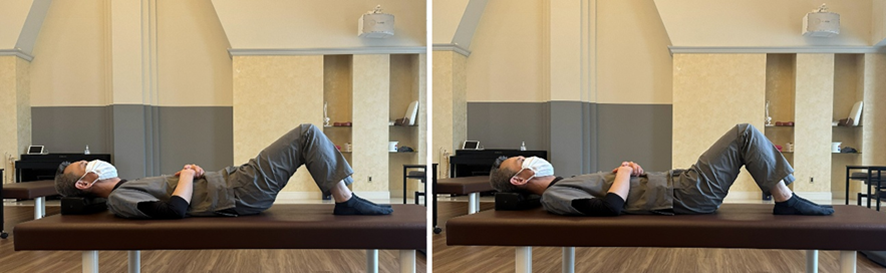
Strengthening the transverse abdominal muscle can reduce the burden on the lower back.
① Lie on your back with your knees bent.
② Take a deep breath and expand your abdomen.
③ Once your abdomen is fully expanded, slowly exhale through your mouth while drawing your abdomen inward.
* Hold the position for approximately 5 seconds.
Repeat steps 2–3 about 5–10 times.
Stretching
Stretches should be performed only to the extent that they do not cause pain.
Consistency is key to improving symptoms. Continuing regularly without overexertion can help improve your condition.
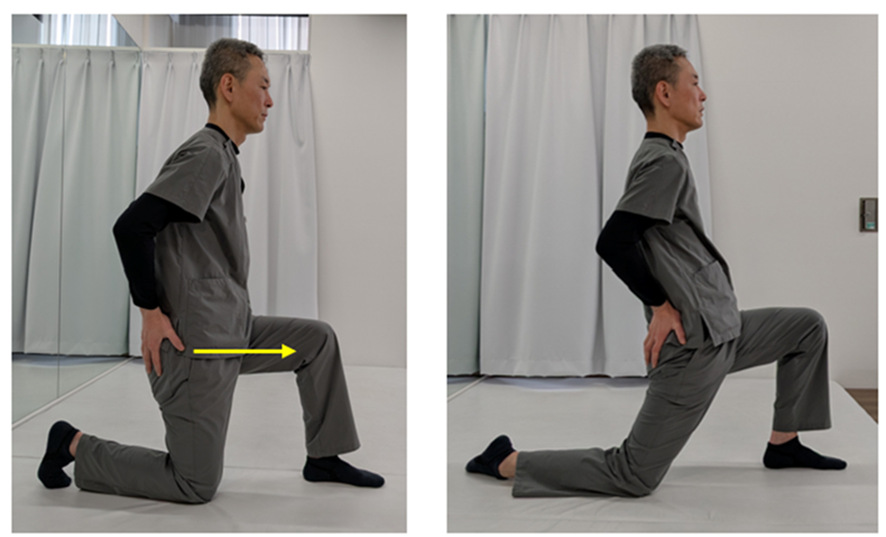
◎ Iliopsoas Stretch (Front of the hip)
This stretch targets the muscles at the front of the hip joint. When these muscles become tight, the pelvis tilts forward, increasing lumbar lordosis (swayback posture), which can worsen lower back pain.
① Kneel on the floor.
② Place your left leg forward in a lunge position.
③ Shift your hips forward.
④ Feel the stretch in the front of your right hip.
⑤ Switch legs and repeat.
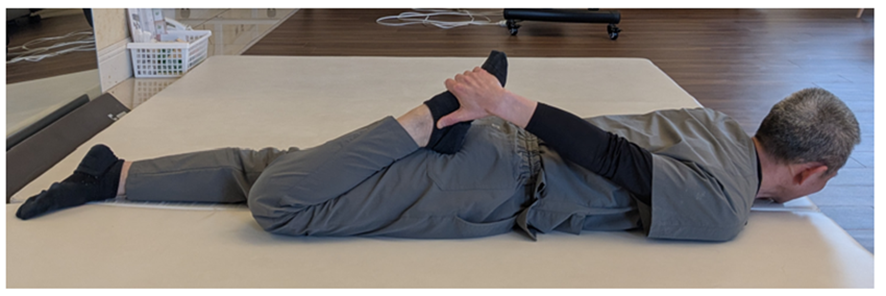
◎ Quad Stretch (Front of the thigh)
This stretch targets the muscles at the front of the thigh.Tight quadriceps can also tilt the pelvis forward and contribute to excessive lumbar curvature, potentially worsening lower back pain.
① Lie on your stomach.
② Bend your right knee.
③ Grasp your foot with your right hand.
④ Feel the stretch in the front of the thigh.
⑤ Switch legs and repeat.
Treatments at Our Clinics
Our clinics offer the Florence Method / Q-Florence Method and the Cellgel Method for spinal canal stenosis.
The Florence Method and Q-Florence Method are minimally invasive treatments with relatively low risk for spinal canal stenosis.
Under local anesthesia and sedation, a device is inserted percutaneously to widen the narrowed spinal canal. The device can also be removed after treatment if necessary.
By inserting the device, spinal stability can be improved while maintaining spinal rotation and flexion. The procedure helps enlarge the spinal canal, suppress disc protrusion, and reduce thickening of the ligamentum flavum.
As the narrowed spinal canal expands, pain is relieved.
These treatments are recommended for patients whose symptoms do not improve with conservative therapy and who wish to avoid open surgery under general anesthesia, such as spinal fusion surgery.
👉 Click here to learn more about the Florence Method
Spinal canal stenosis can occur when cracks form in the intervertebral disc, allowing the inner disc material to protrude and narrow the spinal canal. If these disc fissures are not repaired, recurrent disc herniation or recurrent spinal canal narrowing may occur.
With our Cellgel Therapy, a specialized agent is injected into the fissured portion of the disc. The material then becomes gel-like, filling and reinforcing the damaged area, enabling a fundamental treatment. A key feature of this therapy is that disc volume is preserved, and the gel-like implant remains inside the disc after treatment, helping maintain the intervertebral disc structure.
👉 Click here to learn more about the Cellgel Therapy
In addition, our clinic also provides rehabilitation specialized for lower back pain, enabling us to treat a wide range of lumbar conditions across various age groups.
If you are struggling with spinal canal stenosis, we encourage you to consider visiting our clinic for an evaluation.
Related Articles
Lumbar Spinal Canal Stenosis: What Is Actually Happening to my Body?
What are the Various Complications Possible With Spinal Stenosis?
Why Do The Symptoms of Spinal Canal Stenosis Differ from Person to Person?
Diagnosis and Treatment of Spinal Stenosis: Why Early Detection is Critical
How to Find a Top Specialist to Treat Spinal Canal Stenosis: Tips and Key Points to Check