





Column Why Does Lack of Exercise Cause Back Pain? Introducing Mechanisms and Simple Exercises
February 13, 2026
While back pain has many causes, the primary culprit is a lack of physical activity.
Below, we explain the mechanics of how a sedentary lifestyle leads to pain, and provide actionable steps to counter it.
Why Inactivity Leads to Pain
Back pain stemming from inactivity is usually a combination of weakened core muscles, stiff joints, poor circulation, and weight gain.
Decreased Core Strength and Lumbar Instability
When the deep inner muscles of your abdomen and back weaken, they can no longer hold the pelvis in its proper position. This makes the lumbar spine unstable.
As a result, the superficial back muscles overcompensate to stabilize the spine. This excessive effort causes muscle fatigue, tightness, and stiffness.
Reduced Flexibility
Prolonged sitting, such as during desk work, cause tension in the iliopsoas (hip flexors) and hamstrings (back of the thighs).
Once the hips lose their range of motion, the lower back is forced to move more than it should to compensate, placing an excessive burden on the vertebrae.
Poor Circulation & Fatigue Buildup
Physical inactivity reduces systemic blood flow, limiting oxygen and nutrient delivery to muscles and nerves.
Metabolic waste products and pain-inducing substances accumulate in the muscles, leading to chronic stiffness, heaviness, and pain.
Weight Gain
Lack of exercise can also result in weight gain, which increases the mechanical load on the lumbar spine. Every extra pound adds pressure to the intervertebral discs.
The greater the load on the lumbar vertebrae, the more likely pain will develop.
How to Improve Low Back Pain Caused by Lack of Exercise
To break this cycle, a three-pronged approach is needed: aerobic exercise, stretching, and core strengthening.
Walking
Light aerobic exercise such as walking is quite effective for addressing physical inactivity.
Try 15 to 30 minutes of light aerobic exercise daily. Keep your gaze forward, swing your arms naturally, and keep your core slightly engaged.
Stretching
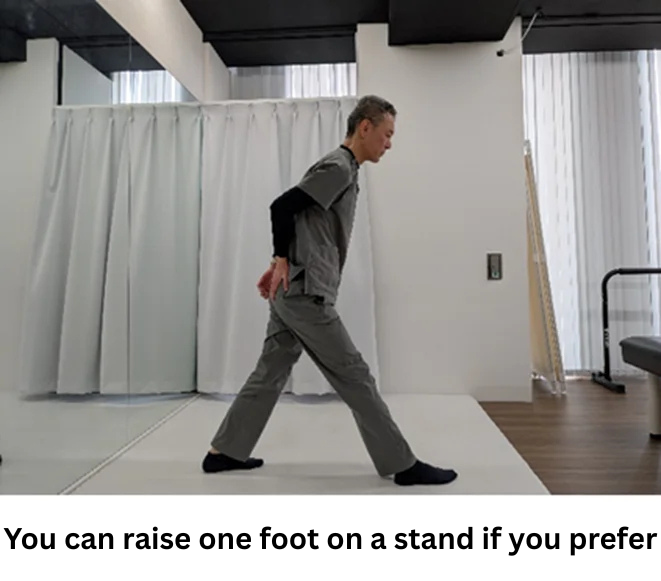
▶ Hamstring Stretch
When hamstrings lose flexibility, the pelvis tilts backward, causing the lower back to round and preventing proper pelvic positioning.
1. Extend one leg straight forward.
2. Keep your pelvis upright and lean your torso toward the extended leg.
3. Switch sides and repeat.
You should feel a pulling sensation along the back of the thigh when properly stretched.
▶ Iliopsoas Stretch
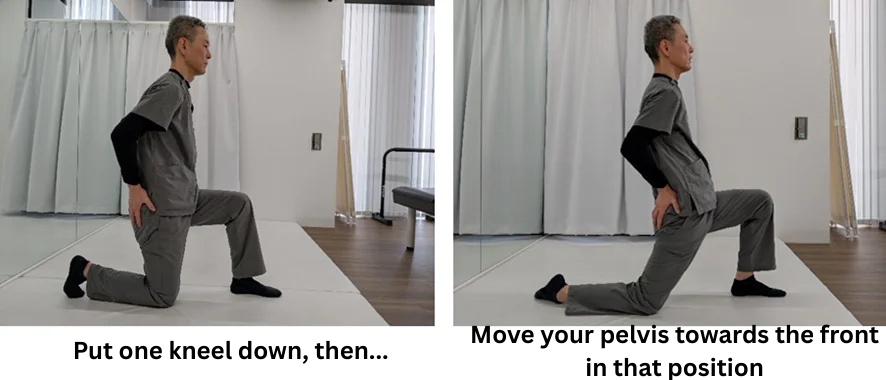
The iliopsoas muscles lifts the hip joint and contributes to anterior pelvic tilt. Stretching these muscles improves hip flexibility and promotes blood flow around the lower back. This can be particularly beneficial when poor circulation is a cause of low back pain.
1. Place one foot forward and lower the back knee to the floor.
2. Place both hands on the front knee and gently lean forward.
3. Slowly return to the starting position.
4. Switch legs and repeat.
Core and Inner Muscle Strengthening
▶ Draw-In Exercise
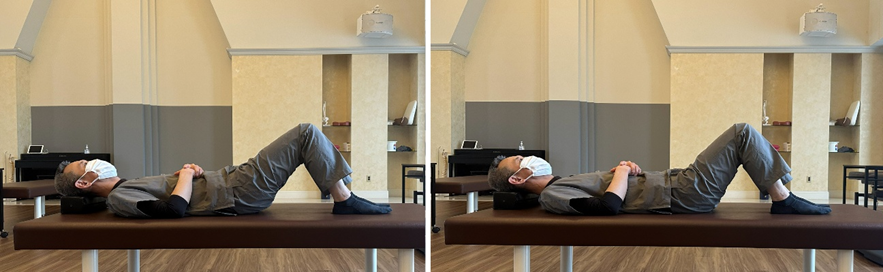
The draw-in exercise trains the deep core muscles by controlling abdominal expansion and contraction.
1. Lie on your back with your knees bent.
2. Take a deep breath and expand your abdomen.
3. Slowly exhale through your mouth while drawing your abdomen inward.
* Hold for approximately for 5 seconds.
Repeat steps 2–3 for 5–10 repetitions.
▶ Abdominal Strengthening
Abdominal strength is crucial for reducing lumbar spine load. When the pelvis can move forward and backward in a controlled way, muscle flexibility will improve.
Caution: traditional sit-ups (lifting the upper body) can actually aggravate low back pain.
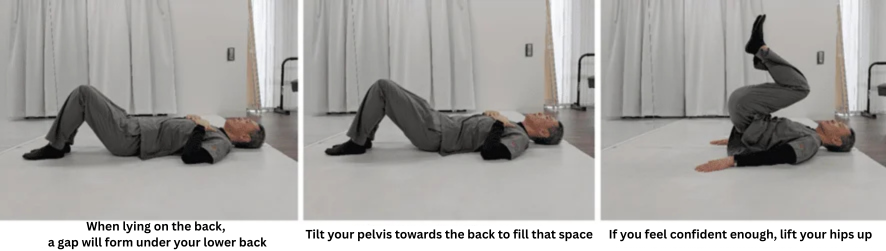
1. Lie on your back and locate the gap between your lower back and the floor.
2. Tilt your pelvis to flatten that gap against the floor.
* If you can do this without problem, proceed to the next step:
3. While on your back, bend and lift both legs. Support your hands at your sides. Lift your hips slightly until your lower back rises from the floor.
Our Clinics’ Treatment
If low back pain occurs, it is essential not to ignore it and to seek evaluation by a specialist. Early diagnosis and appropriate treatment can prevent worsening and may allow for full recovery.
Our clinic provides the Cellgel Method, a treatment designed to repair damaged intervertebral discs.
In the Cellgel procedure, a medical agent is injected to fill cracks in the disc. The agent solidifies into a gel, reinforcing the damaged area. Because disc volume is preserved and the gel remains as an implant within the disc, the intervertebral disc itself can be preserved.
Click here to learn more about the Cellgel Method
If you are suffering from low back pain, we encourage you to consider consulting at our clinic.
Related Articles
Differences Between Western and Eastern Medicine in Relation to Low Back Pain
If You Led This Kind of Lifestyle as a Youth, You Have a Time Bomb Ticking in Your Lower Back!
🛌The Relationship Between Back Pain and Sleep: How to Create a Comfortable Sleeping Environment🛌
The Relationship Between Stress and Back Pain: How to Maintain Good Mental and Physical Health
Lower Back Pain and Postural Improvement: Prevent Pain with The Correct Posture