





Column Finding the Exact Cause of Your Pain: The Importance of Detailed Examination and Diagnosis at Our Clinics
July 10, 2026
There are many possible causes of lower back pain, including intervertebral disc degeneration, disc herniation, spinal scoliosis, and facet joint issues.
Because these conditions are often interconnected, it is essential to first assess the condition of the patient comprehensively before proposing an appropriate treatment.
In this article, we explain the diagnostic approach used at our clinic.
Specific vs. Non-Specific Lower Back Pain
Lower back pain is broadly divided into specific lower back pain and non-specific lower back pain.
Specific lower back pain refers to conditions such as lumbar disc herniation and spinal canal stenosis, where a specific cause can be identified. These conditions can often be identified through imaging examinations such as MRI.
Non-specific lower back pain is pain for which the cause is difficult to determine through imaging examinations such as MRI. It is estimated that approximately 85% of lower back pain is non-specific.
At our clinic, in addition to imaging examinations such as MRI, we conduct detailed interviews regarding each patient’s symptoms—including lower back pain, numbness, and difficulty walking— and dives deep into each individual lifestyle background to analyze back pain from multiple angles.
Through this approach, we clarify both the causes of back pain visible on imaging and those that cannot be seen on imaging alone.
Examination for Specific Lower Back Pain
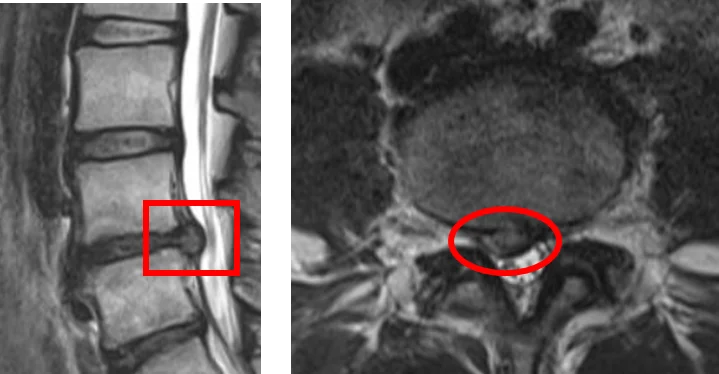
MRI imaging allows us to examine deformations of the articulations and damage involving the intervertebral discs, nerves, ligaments, and joints, as well as the degree of nerve compression and the presence or absence of inflammation that may be associated with lower back pain.
MRI images can clearly demonstrate the extent of lesions, allowing for an accurate diagnosis.
Diagnosing Non-Specific Lower Back Pain
While MRI scans can help diagnose conditions like lumbar disc herniation and spinal canal stenosis, in many cases, the root cause of back pain is not limited to those findings alone.
Therefore, we make a comprehensive assessment of the causes of pain that cannot be identified through imaging by examining signals from the body as well as from the brain.
Signals from the body refer to cases where the cause of pain or numbness actually lies within the body’s tissues or structures.
For example, subtle nerve inflammation that is difficult to detect on MRI images, muscle dysfunction—such as muscles that become excessively tense or, conversely, weak during certain movements—and fascial adhesions that cause the fascia covering the muscles to stiffen are all examples of signals from the body.
These issues are often overlooked in standard MRI or X-ray examinations.
At our clinic, we sometimes combine ultrasound diagnostics with nerve conduction studies to identify these subtle issues and uncover the root cause of the pain.
When chronic stress, anxiety, or past traumatic experiences accumulate, the part of the brain responsible for pain becomes hypersensitive. As a result, even after the physical problem has been resolved, the brain may continue to send pain signals on its own. Even slight stimuli may be perceived as intense pain, or pain may be felt in situations where one would not normally experience it.
To identify these signals from the brain, our clinic first confirms through tests such as MRI that there are no obvious physical causes, and then conducts a detailed medical interview and psychological evaluation. This allows us to comprehensively determine whether the cause of the pain is physical or due to excessive brain activity.
Treatments at Our Clinics
Our clinic offers the Cellgel Method—a treatment designed to repair damaged intervertebral discs.
With the Cellgel Method, a therapeutic agent is injected into the cracked areas of the intervertebral disc. The agent forms a gel and fills the cracks, allowing for a fundamental treatment that addresses the underlying disc damage.
Learn More About the Cellgel Method
In addition, at our OJ Wellness Center, we provide rehabilitation specifically focused on lower back pain, incorporating approaches from Traditional Eastern Medicine and Ayurvedic Medicine.
Learn More About the OJ Wellness Center
If you are suffering from lower back pain, please consider scheduling a consultation at our clinic.
Related Articles
What Is a Lumbar Disc Herniation and Why Is an MRI Necessary? Understanding How Diagnosis Is Made