





Column The Secret to Relieving Lower Back Pain is Good Sleep: How to Choose Bedding and Optimize Your Sleeping Position
July 3, 2026
When you suffer from lower back pain, it is not uncommon to have trouble falling asleep, wake up during the night, or experience increased pain upon waking in the morning.
In this article, we explain the relationship between lower back pain and sleep, as well as how your bedding and sleeping position may affect your symptoms.

The Relationship Between Sleep and Lower Back Pain
Lower back pain and sleep are intricately connected and can be described as a “two-way vicious cycle.”
When you have lower back pain, you naturally toss and turn less to avoid pain, which increases physical stress on the lower back and can cause the pain to worsen. Furthermore, pain can wake you up during sleep, preventing you from getting sufficient rest.
Conversely, when you lack sleep due to factors such as stress, brain function declines and causes you to become more sensitive to pain, magnifying its intensity. A chronic lack of sleep disrupts the autonomic nervous system, causing body-wide muscle tension and stiffness that places an even heavier stress on your lower back.
Factors that Trigger or Worsen Back Pain During Sleep
Sleeping posture, reduced tossing and turning, and improper bedding can all contribute to lower back pain.
Sleeping Postures
The way you sleep can sometimes contribute to lower back pain.
Sleeping on your back (Supine): While this distributes body weight evenly, reduces physical strain, and makes tossing and turning easier, sleeping with fully extended legs causes the lower back to over arch, leading to strain and pain.
Sleeping on your side (Lateral): Legs and arms tend to twist into an asymmetrical position, placing uneven strain on the lower back.
Sleeping on your stomach (Prone): Forces the lower back to arch excessively, placing heavy strain on the lumbar spine and contributing to spinal misalignment. Excessive arching will provoke or worsen back pain.
Reduced Tossing and Turning
Tossing and turning during sleep plays a vital role in maintaining blood circulation and relieving muscle tension.
If your bedding is not adapted or you are overly fatigued, you may move less during sleep, causing lower back muscles to stiffen and resulting in back pain when you wake up in the morning.
Bedding Issues
Bedding or mattresses that are too soft can allow the lower back to sink too deeply, while bedding that is too firm may prevent the lower back from being adequately supported. Both situations can place stress on the spine.
Mattresses and bedding that are too thin can also place additional stress on the lower back and potentially trigger pain.
Solutions to Prevent Lower Back Pain from Worsening
Choosing the Right Bedding
Try to avoid excessively soft futons or mattresses. A firmer, high-resilience mattress can help prevent the body from sinking too deeply while providing support for the back, potentially reducing stress on the lower back during sleep.
Similarly, because bedding that is too thin can place additional stress on the lower back, it is recommended to choose bedding with sufficient thickness.
Choosing the right pillow is also important. Select a pillow that provides an appropriate height and support for your neck. Proper neck support can help maintain the alignment of the entire spine and may contribute to reducing discomfort.
If your body becomes cold while sleeping, you may naturally curl up, which can place additional stress on the lower back. Choosing bedding made from highly insulating natural materials, such as cotton, can help keep the body warm.
Sleeping Positions That Reduce Stress on the Lower Back
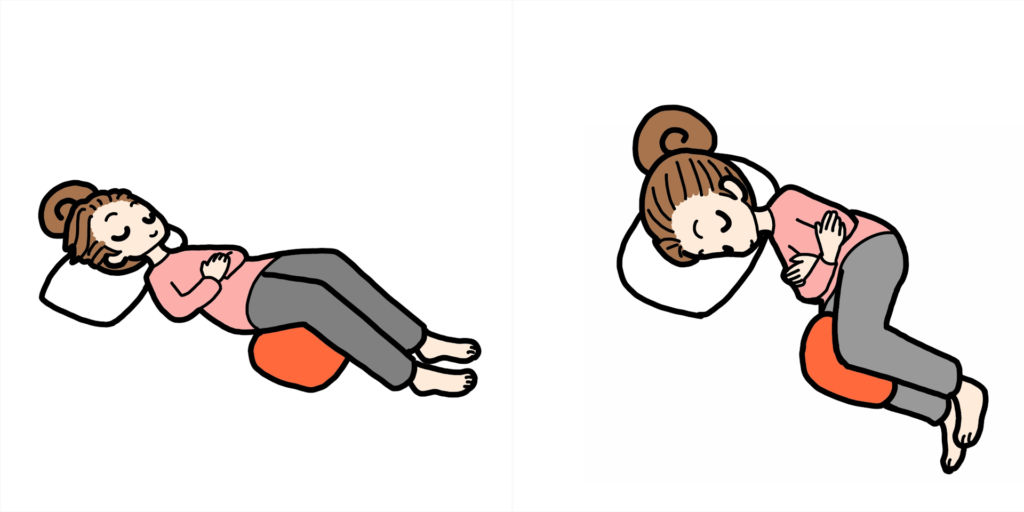
When sleeping on your back: The key is to elevate your legs to relieve pressure on the lower back. We recommend placing a rolled-up towel or blanket under your knees so they stay bent at a 90-degree angle.
When sleeping on your side: The key is to bend your legs. Placing a cushion between both knees keeps your back and legs horizontally aligned, stabilizing the pelvis and alleviating pain. Curling your body slightly forward can also make sleeping more comfortable.
Avoid sleeping on your stomach: Because prone sleeping places excessive strain on the lower back, it is strongly recommended to avoid this position.
Treatments at Our Clinics
If lower back pain develops, it is extremely important not to leave it untreated and to seek a diagnosis from a specialist physician. Early detection and proper treatment can prevent aggravation and make complete recovery possible.
At ILC International Lumbago Clinic, we offer the Cellgel Method, a treatment designed to repair damaged intervertebral discs.
Our clinic offers the Cellgel Method—a treatment designed to repair damaged intervertebral discs. With the Cellgel Method, an agent is injected to fill the cracks within the disc. The agent turns into into a gel format to seal and repair the fissures, providing a fundamental treatment. A key feature of this procedure is that intervertebral disc volume is not reduced; after treatment, the agent remains inside the disc as a gel implant, fully preserving the disc structure.
Learn More About the Cellgel Method
In addition, at our OJ Wellness Center, we incorporate approaches from Eastern medicine and Ayurveda and provide rehabilitation programs specifically designed for patients with lower back pain.
Learn More About OJ Wellness Center
If you are suffering from lower back pain, we encourage you to have your condition evaluated at our clinic.
Related Articles
If You Led This Kind of Lifestyle as a Youth, You Have a Time Bomb Ticking in Your Lower Back!
The Relationship Between Stress and Back Pain: How to Maintain Good Mental and Physical Health
Lower Back Pain and Postural Improvement: Prevent Pain with The Correct Posture
Why Does Lack of Exercise Cause Back Pain? Introducing Mechanisms and Simple Exercises