





Column Is Surgery the Only Treatment Option for Disc Herniation? Conservative Treatments To Help Improve Your Symptoms
June 26, 2026
Lumbar disc herniation is the most common spinal disorder.
In this column, we will explain the different conservative therapy options available for lumbar disc herniation.
What is Lumbar Disc Herniation?
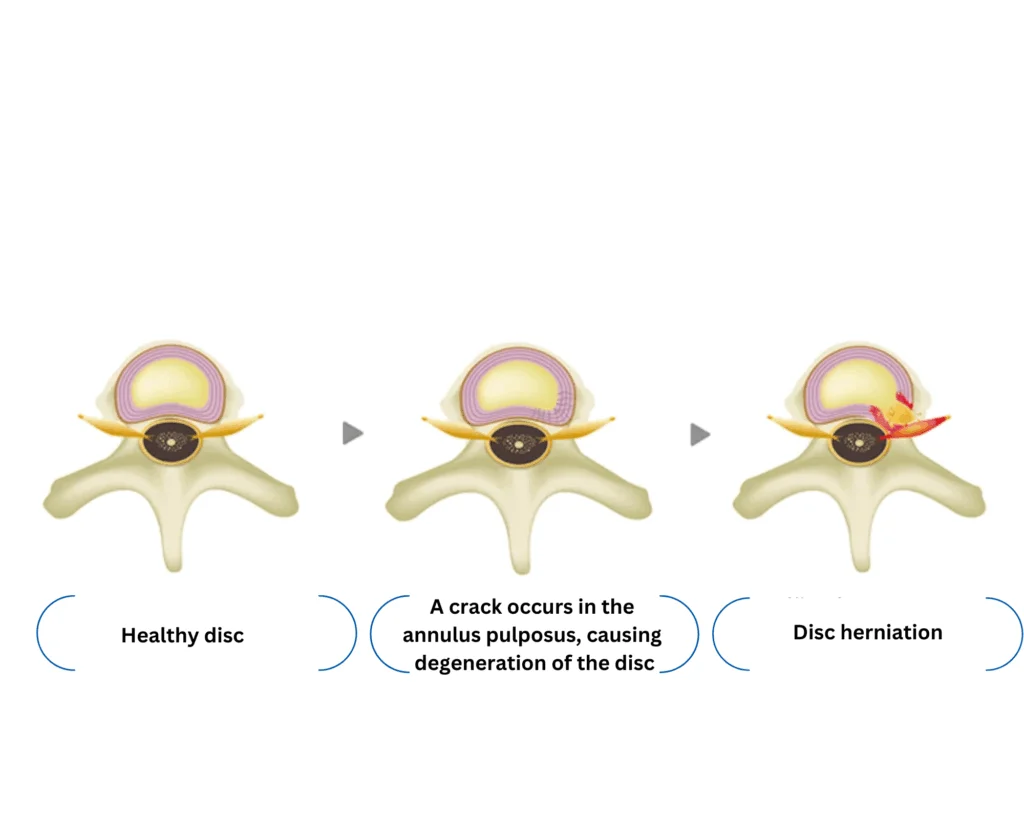
Between each vertebra lies an intervertebral disc, which acts as a shock absorber for the spine. At the center of each disc is a gelatinous nucleus pulposus, surrounded by the collagen-rich annulus fibrosus.
When a tear occurs in the annulus fibrosus and the nucleus pulposus protrudes outward, this condition is known as a lumbar disc herniation.
Symptoms of Lumbar Disc Herniation
The main symptoms of lumbar disc herniation, in addition to lower back pain, include pain and numbness in the buttocks and legs. Pain or numbness can appear anywhere in the lower body, but pain extending from the buttocks down the back of the thighs — commonly known as sciatica — is one of the hallmark symptoms of lumbar disc herniation.
Other signs may include lateral curvature of the spine, reduced mobility, or pain that intensifies when lifting heavy objects. Symptoms may develop suddenly or manifest gradually over time.
In cases where nerves are severely compressed, symptoms such as difficulty urinating, impaired bowel movements, and loss of bladder or bowel control may occur.
Non-Surgical Treatment Options for Disc Herniation
Whenever people hear “disc herniation,” many immediately think of surgery as the only solution to do away with the herniated tissue. However, depending on symptoms and test results, surgery may not always be required. Depending on the patient’s symptoms and imaging findings, many cases can be managed conservatively.
If pain fluctuates throughout the day or gradually decreases over time, doctors frequently opt for a conservative wait-and-see approach before considering surgery.
Medication Therapy
While several methods exist to relieve pain, medication is one of the most common approaches for relieving symptoms associated with lumbar disc herniation.
Medications effective for lower back pain are available as oral drugs, pain patches, and topical ointments/creams.
・Oral Medications
Options include analgesics (pain relievers), vitamin supplements, muscle relaxants to ease stiffness, and traditional Japanese herbal (Kampo) medicine, selected according to specific symptoms.
Some medications should not be combined because they contain similar active ingredients or may increase the risk of side effects.
For this reason, medications should always be taken exactly as prescribed by a physician.
・Medicated Patches
Topical patches (such as anti-inflammatory patches) adhere directly to the painful area and provide continuous therapeutic action through direct skin contact. They are recommended for patients who cannot take oral pain medications due to stomach irritation or gastrointestinal side effects.
・Topical Creams and Gels
Topical medications offer the advantage of causing less skin irritation and moisture buildup than adhesive patches. They are inconspicuous when applied and convenient for use while away from home.
However, topical ointments require reapplication several times throughout the day.
Rehabilitation & Exercises
To prevent symptoms from worsening and to avoid recurrence, daily exercises such as stretching are effective.
Performing targeted stretches can:
① Improve muscle flexibility around the lower back and legs.
② Maintain proper spinal alignment without excessive lumbar extension
These factors significantly contribute to preventing both the aggravation and recurrence of lumbar disc herniation.
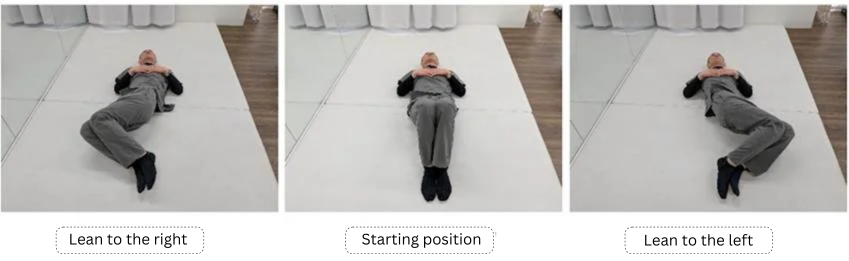
◎ Lumbar Rotation Stretch
- Lie flat on your back with your knees bent.
- Slowly rotate your legs to the right and left sides (rotating the entire lower torso).
※Note: Perform this slowly while exhaling continuously over time.
Repeat the movements for about 1 minute.
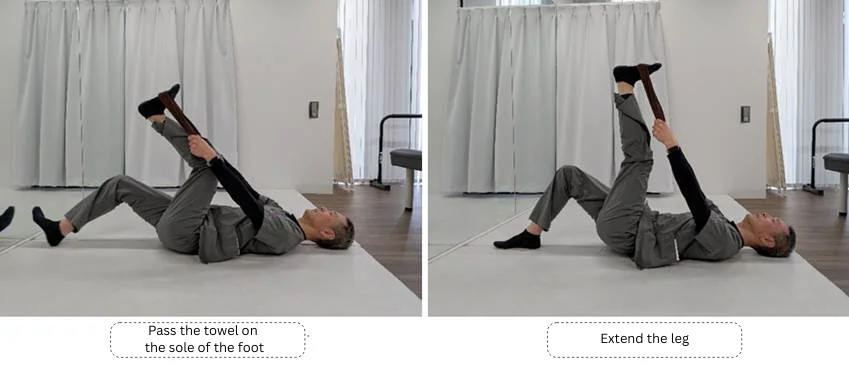
◎ Plantar Fascia Towel Stretch
- Lie flat on your back with your knees bent.
- Hold both ends of a towel with your hands and loop it around the sole of one foot.
- Remaining on your back, extend the leg holding the towel upward at an angle of about 60 degrees relative to the floor.
- Hold the position for 10 seconds while exhaling slowly.
- Repeat the exercise with the other leg.
Adjust towel length as needed to ensure you feel a comfortable, moderate stretch along the back of the calf and thigh.
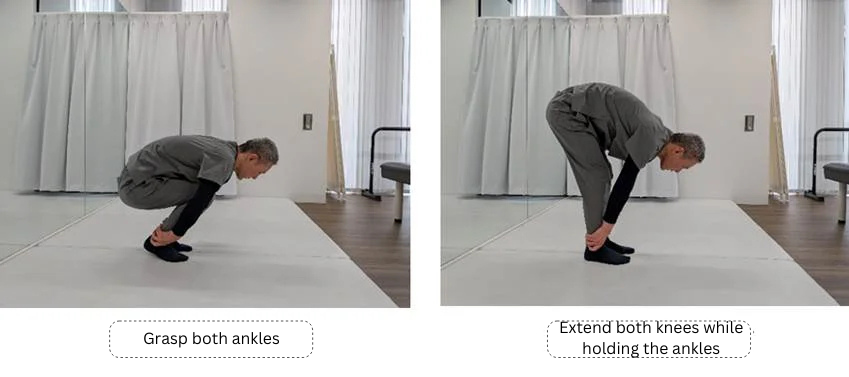
◎ Standing Hamstring Stretch
This stretch extends the muscles along the back of the thighs, preventing excessive strain on the lumbar spine.
- From a standing position, squat down and grasp both ankles with your hands.
- Extend both knees while keeping your chest in front of your thighs.
- Hold that pose for 10 seconds while exhaling slowly.
Focus on keeping your chest and thighs together. If fully extending your knees is difficult, keeping them slightly bent is acceptable.
Our clinics’ treatment
For patients diagnosed with a lumbar disc herniation, treatment may need to address the underlying damage to the intervertebral disc, rather than simply controlling symptoms.
ILC International Lumbago Clinic offers the Cellgel Method, a minimally invasive procedure designed to repair damaged intervertebral discs.
With our Cellgell Method, a therapeutic agent is injected into tears or cracks within the disc. The agent then turns into a gel that reinforces the damaged area while preserving the disc, thus providing a root-cause treatment. Because this approach does not reduce disc volume and the agent subsequently remains inside the disc as a gel implant, the natural structure of the disc can be preserved.
👉 Click Here to Learn More About The Cellgel method
Additionally, through the OJ Wellness Center, our clinic offers specialized lower back rehabilitation integrating Eastern medicine and Ayurvedic medical approaches.
👉 Click Here to Learn More About The OJ Wellness Center
If you have been diagnosed with lumbar disc herniation, please schedule a consultation with us to determine the most appropriate treatment for your condition.
Related Articles
Understanding Disc Herniation and Receiving the Most Appropriate Treatment For It
Can Disc Herniation Heal Naturally?
Symptoms and Treatments of Disc Herniation: When Early Detection is Key
What Is a Lumbar Disc Herniation and Why Is an MRI Necessary? Understanding How Diagnosis Is Made
Prevention Rather Than Intervention: Precautions to Take to Prevent Herniated Discs
⚠️The 5 Characteristics of People Prone to Disc Herniation ⚠️
The Different Types of Disc Herniation Surgery and How to Choose the Right One For You